Navigating disruption: Lessons from a slip
In his latest blog post, Dr Jo Scott-Jones reflects on his experiences travelling between Gisborne and Ōpōtiki during a recent land slip, sharing the lessons it offered about preparedness, connection, and how unexpected disruption can sharpen our learning.
I was travelling from Gisborne, where I had been working in a clinic, to Ōpōtiki. I'd been planning on a day in my own clinic on Friday 16 January 2026 so left at 5:30am. I checked the roads and weather before leaving as the gorge is vulnerable to slips – it was all good when I set off.
The gorge rises to a peak after the township of Mātāwai and at the very top it was starting to rain. It did not ever feel horrendous but over the next few hours a month’s worth of rain was concentrated into the gorge.
As I descended there were a few small slips and flooding over the road, but when I got to the last few kilometers I thought I was through the worst of it. I came round a corner and was the third vehicle behind a relatively small but “active” slip (video 1).
I thought I’d wait it out in the queue until the truck in front of me asked to back up, because the cliff next to him was starting to slip. I decided at this point I’d turn around and park in what I hoped would be a safer place on the road.
There was no cell phone coverage at this point in the gorge.
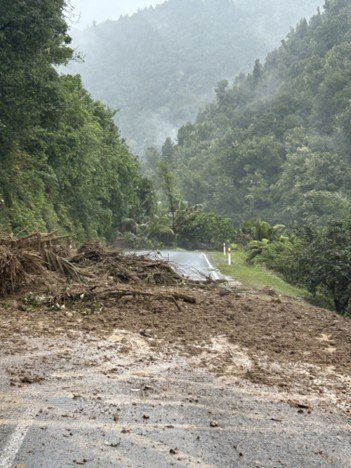
I stopped at a rest place about 1km up the road as there were two cars parked there. Braving the, now torrential, rain I approached one and found an old friend and very practical problem solver (he used to drive very big cranes) - Karl Butler - who said he’d tried gong back but there were slips now blocking the road behind us (picture 1) and the emergency phone on the side of the road at that point had been vandalised.
Karl set off in his ute looking for help. I was able to get changed into dry clothes as I had been staying over in Gisborne for a few days, working in a clinic there, and had a suitcase in the car. I regretted not bringing a raincoat and not stocking up on snacks and water before heading off that morning.
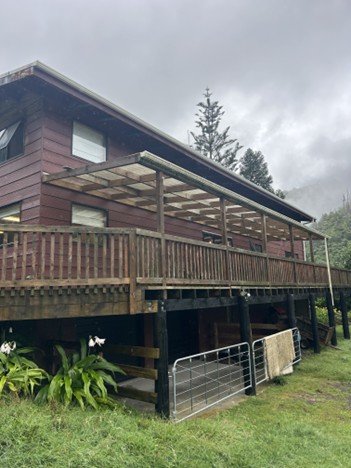
I was settling in for a sleep in my car when Karl came back, having found a local farmhouse (picture 2) able to provide us with a cup of tea and wifi so we could call home.
Over the day, the other cars eventually came up to the farm, after the first road blockage - known now as the Goldsmiths slip - suffered further slippage after almost being cleared by roadworkers. This second slippage created a huge problem that the travellers could see was not going to be cleared in a day.
More slips had occurred between the travellers and the Oponae lodge (video 2) that made it hard for the travellers to get back out of that space – but they managed, courageously traversing the washed out roads. Eventually there were 14 waifs and roadside strays in the farmhouse.
We were warm, dry, fed, able to access communication, and incredibly lucky to find this amazing family to care for and support us, and the others living in the surrounding area, as we hunkered down.
About 40 other people were caught between slips on the side of the road between Oponae and Mātāwai, they were not so lucky. They were gradually picked up by small helicopters, evacuated to a camp site from where the large defence chopper was able to pick them up. But it would have been a wet, cold, hungry and frightening experience for most of them, being stuck on the side of the slipping road with no communications for most of the day.
One person in our group took charge of external communication, connecting in with local Police, and search and rescue teams. We were also fortunate enough to have someone with us who was able to connect us to the main emergency response team, which was based in Rotorua, so we could inform and be informed about the state of play.
Despite this there was a lot of confusion, with differing news coming every half an hour through the day, about the state of the roads, potential slip recovery, and evacuation.
It became clear we were in this for the long haul when Waka Kotahi Land Transport Agency announced late in the afternoon that the roads were going to be closed for at least two days.
One member of our party, a past captain of superyachts and now a farmer with 1,000 cows, quickly organised a private chopper to start evacuating four people at a time over the evening.
I was one of five wanting to go to Ōpōtiki, with the others heading in the opposite direction, so I ended up staying overnight with four others who wanted to go to Gisborne but could not afford the helicopter fee.
Over the day and night, I saw seven local people for GP consults, checking on chronic diseases, making sure people were going to be stable over the next few weeks and organising medications to be choppered in the next morning.
I did a home visit on a quad bike to a tent site on the banks of the river, which while by then subsiding, had licked the base of their generator at the height of the flooding.
I was helicoptered out the next morning (for free – with all the possessions I had packed into my car for the Gisborne trip, including my guitar!) after Civil Defence had organised evacuations.
In video 3, taken as I was flown out on Saturday 17 January, you see the big slip that stopped us moving forward – The Goldsmiths slip – estimated to be 110m high and 60m wide. There were more slips ahead and behind us on the roads, with several large slips between Oponae and Mātāwai.
As I write on Wednesday 21 January, the roads remain blocked, my car parked with several others in a paddock at the Oponae Lodge, with an indication from Waka Kotahi Land Transport Agency that they will start to extract the vehicles via flatbed truck once a single lane road is opened. But that may be several weeks away.
What lessons did I learn?
Firstly – how people react in a crisis.
It was inspiring to see how kind, positive, welcoming and generous people are when a crisis occurs. The family who cared for us was amazing, but as a group of quite disparate strangers everyone focused on others and what we could do to help.
Secondly – carry a coat.
Being cold, wet and hungry on the side of the road is never going to be good. I can’t control the weather, or whether or not there is cell phone coverage. I could look at getting a phone with a satellite connection that would give me more than a 111-call capability, but I will pack a coat and some snacks and water for my car journeys for the future.
Thirdly – restock my medical bag.
I have a medical bag, mostly diagnostic kit, in my car most of the time. I no longer carry a stocked medical bag with me because I do not do that many house calls in emergencies. But I need to have my diagnostic kit to hand.
As we had internet access, I was able to log into my PMS and send scripts to the pharmacy and record my consultations. But initially I was pleased to have my old paper prescription pad with me so that even if I’d not been able to log in, I would have been able to send a picture of a script to a pharmacy as a work around.
I will stock my personal 'toiletries' bag with a few vials of adrenaline, syringes and needles, as at the end of the day, having these with me could help me save a life.
Many, many thanks to the emergency response teams, and especially the family who cared for us so well.
After 27 years with Kawhia Health Centre practice manager Heather Sherman is moving on, literally, in her (stunningly beautiful!) campervan with (equally stunning!) dog Jaxon by her side.
Read moreBay of Plenty/Waikato Faculty of RNZCGP invites all GPs (including non-faculty members) and GP registrars in the GPEP programme (years 1-3) to register for collegial support service – Ka Hono.
Read moreThis new programme is a collaboration between Te Runanga o Kirikiriroa (Facilitation Service) and general practices.
View detailsThe Children's Act came into effect on 1 July 2015. Learn what is in a worker safety check, download resources to help with this and learn more about our police vetting service.